
Looking for AR VR courses in Chennai to break into one of tech’s most exciting fields? You’re in the right place.

This ultimate guide covers everything one need to know about the academy teaches virtual reality courses in chennai to picking the right immersive technology courses to landing your dream job.
This guide is perfect for fresh graduates who completed their degree ready to dive into emerging tech, working professionals wanting to upskill their careers, and tech enthusiasts curious about AR VR career opportunities. You’ll get the inside scoop on what it takes to succeed in this rapidly growing industry.
We’ll walk you through the essential skills you need to master before starting your journey, plus give you a detailed breakdown why immersive skills academy is the best place to study AR VR courses in Chennai.
By the end of this guide, you’ll know exactly which AR VR certification programs match your goals and how to take the next step toward your new career in Chennai’s thriving tech scene.
Evolution of AR VR Technologies – Slides
Key differences between Augmented Reality and Virtual Reality
You might think AR and VR are the same thing, but they’re actually quite different technologies. Virtual Reality completely immerses you in a digital world where everything you see is computer-generated. When you put on a VR headset, you’re transported to entirely new environments –
“Whether that’s virtually walking through ancient Hampi or undergoing safety training inside a ship’s hull”
Your real-world surroundings disappear completely.
Augmented Reality, on the other hand, adds digital elements to your real world. Think of Cardskool as an Augmented Reality mobile app for pre-school children that allows them to bring animals into their real world and take selfies with their favorite creatures or Instagram filters that put digital sunglasses on your face. AR enhances what’s already there rather than replacing it entirely.
| Feature | Virtual Reality (VR) | Augmented Reality (AR) |
|---|---|---|
| Environment | Fully digital | Real world + digital overlay |
| Hardware | VR headsets, controllers | Smartphones, AR glasses, tablets |
| User experience | Complete immersion | Enhanced reality |
| Applications | Gaming, training simulations , etc | Marketing, navigation, education, Remote Troubleshooting, etc |
Both technologies require different skill sets and development approaches, which is why many AR VR courses in Chennai cover both specializations to give you maximum career flexibility.
“If you want to clearly understand the differences between AR, VR, and MR, schedule a demo class.”
Growing job market for AR VR technologies in Chennai’s tech sector
Chennai, being one of the major manufacturing hubs for industries like automotive and component manufacturing, makes it easy for employers to find the necessary expertise and employ them in their ongoing XR initiatives. The demand for skilled professionals is on the rise in job portals, and you’ll find opportunities across multiple industries that have embraced these technologies.
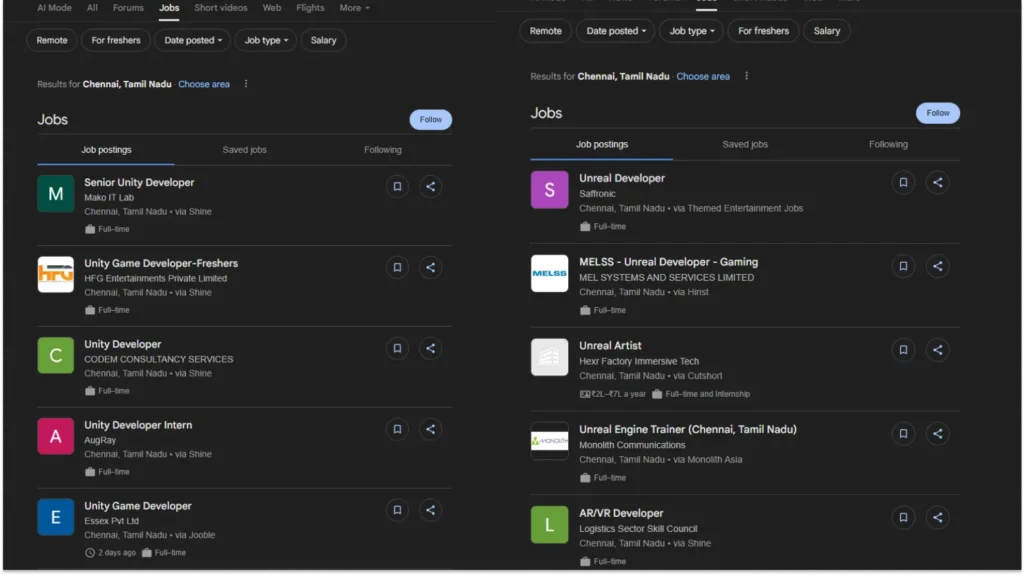
The automotive sector in Chennai, including major manufacturers like Ford and Hyundai, Royal Enfield actively recruits AR VR specialists for design visualisation and virtual prototyping. Educational institutions are also jumping on board, requiring experts who can develop interactive learning modules and virtual classrooms.
Tech giants like TCS, Infosys, Wipro and Tech Mahindra have established dedicated AR VR divisions in Chennai, creating hundreds of job openings. Startups focused on AR VR solutions are also sprouting up across the city, offering you chances to work on cutting-edge projects from day one.
Your timing couldn’t be better – the Chennai tech sector is experiencing a shortage of qualified AR VR professionals, which means companies are willing to offer competitive packages and faster career growth to attract talent.
High-paying career paths in AR VR development
Your earning potential in AR VR development course can be substantial, especially as you gain experience and specialise in specific areas. Entry-level AR/VR developers in Chennai typically command starting salaries ranging from ₹3.5 to ₹6.0 LPA, depending on their portfolio strength and platform certifications.
Senior AR VR Developer positions can command ₹8-15 lakhs per year, Specialised roles offer even higher compensation AR VR Consultants working with multiple clients works on hourly rates . The beauty of this field is that you can also work as a freelancer, charging premium rates for specialised projects.
Your location advantage in Chennai is significant – the cost of living is lower than Bangalore or Mumbai, giving you higher purchasing power even with comparable salaries. The city’s robust transportation infrastructure, including metro and local train services connecting areas like Tambaram to Chennai Central, makes it easy for outstation students to find affordable accommodation and hostel facilities in the suburbs while maintaining convenient access to XR training academies located in the city center.
Many professionals who complete AR VR certification programs find their income doubling within 2-3 years of entering the field.
Your investment in professional AR VR courses today
The demand for AR VR professionals is showing solid growth momentum, with global shipments for AR/VR headsets growing 10% in 2024 according to new data from the International Data Corporation (IDC) IDC – AR & VR Headsets Market Insights.
Your investment in professional AR VR courses today positions you perfectly for this growth wave. Companies are already struggling to find qualified professionals, and this talent gap will only widen as more industries adopt AR VR technologies. Chennai’s position as a Manufacturing hub makes it well-positioned for AR VR industry growth, with many companies willing to train the right candidates who have foundational skills from quality training institutes.
Essential Skills Required for AR VR Success
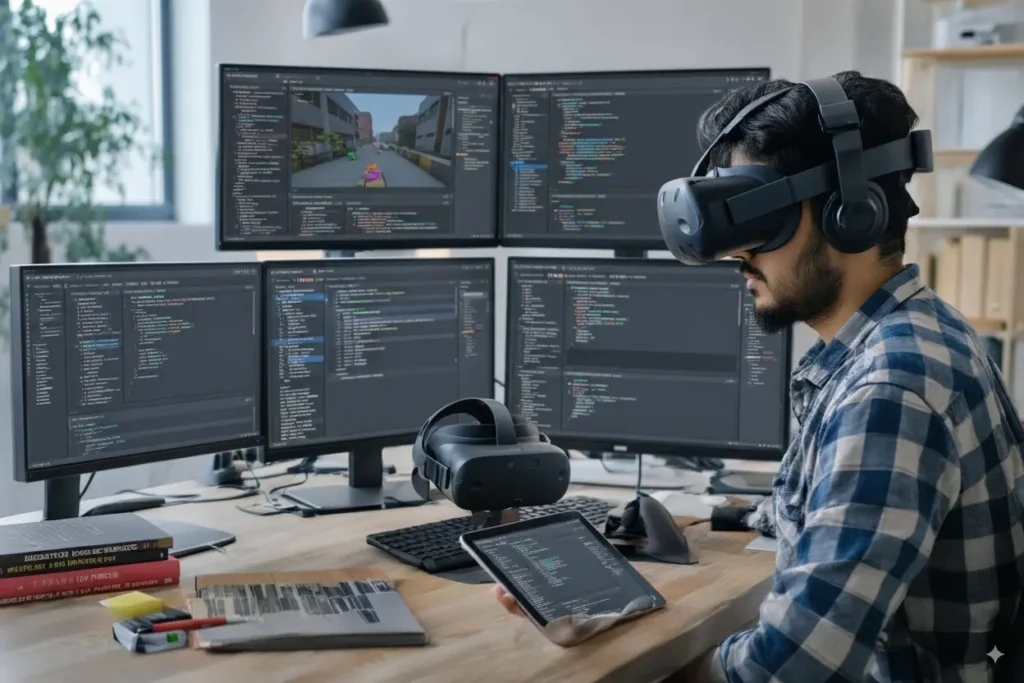 Student in VR Classroom[/caption]
Programming Languages Needed for AR VR Development
Your journey in AR/VR development begins with mastering the right programming languages. Each language serves a unique role in building interactive and high-performance immersive applications.
C# – The Unity Powerhouse
Primary language for Unity, the leading AR/VR engine
Enables:
Interactive experiences : XR, Games, etc
Game object management
Complex user interactions
C++ – Performance & Unreal Engine
Core language for Unreal Engine development
Ideal for performance-critical applications like AEC interactives
JavaScript & TypeScript – Web AR Solutions
Go-to languages for Web AR platforms like 8th Wall, Mattercraft
Work seamlessly with frameworks such as:
A-Frame
Three.js
Perfect for browser-based immersive experiences
Python – AI & Computer Vision Integration
Widely used for:
Machine learning integration
Computer vision tasks
Powers advanced AR features like object recognition and environment understanding
2D Art & User Interface Design
Creating compelling AR VR experiences requires strong 2D design foundations. While 3D assets drive immersion, the user interface and visual consistency define usability and comfort.
Core Tools
Adobe Photoshop & Illustrator → for crafting textures, UI elements, and marketing assets
Sketch & Figma → for designing spatial interfaces adapted to 3D environments
Designing for Spatial Interfaces
Interfaces must work in three-dimensional space, considering:
Depth and distance
User movement and perspective
Intuitive, immersive layouts
Typography in AR VR
Readability is affected by virtual distance and environmental lighting
Scalable UI systems ensure clarity across:
Different headset resolutions
Varying viewing conditions
Color Theory & Consistency
AR VR color design is more complex than 2D apps
Must account for:
Different display technologies (OLED, LCD, etc.)
Lighting variations within environments
Goal → Maintain visibility, contrast, and user comfort
3D Modeling and Animation Expertise
Your success in AR/VR development depends heavily on strong 3D content creation skills. The following tools and techniques are central to building immersive experiences:
Modeling & Animation Tools
Blender – A free, comprehensive solution for modeling, texturing, and animation. It integrates smoothly with game engines like Unity and Unreal.
Maya & 3ds Max – Industry standards for professional character animation and complex scene creation, widely used in studios.
Texturing Workflow
Substance Painter – Essential for PBR (Physically Based Rendering) texturing.
Allows you to paint directly onto 3D models.
Automatically generates texture maps such as albedo, normal, roughness, and metallic.
Ensures consistency when importing assets into Unity or Unreal Engine.
PBR Materials & Realism
Understanding PBR materials is key to creating realistic surfaces.
Assets will respond naturally to virtual lighting, making environments feel more immersive and believable.
Animation Beyond Characters
Animation skills are not limited to character movement. They also include:
Environmental animations (e.g., doors opening, trees swaying).
Particle effects (e.g., fire, smoke, magic).
Interactive object behaviours that enhance immersion.
Hardware & Software Integration in ARVR
Building immersive AR/VR applications requires a strong understanding of how software interacts with specialised hardware. Success depends on optimising for different devices, sensors, and system constraints.
Headset SDKs & Platforms
Work with SDKs from devices like:
Meta Quest 3 series
Each platform has unique capabilities, APIs, and limitations that shape development choices.
Tracking Systems
Different approaches define how users interact:
Inside-out tracking → Cameras on the headset
Outside-in tracking → External base stations
Marker-based tracking → Visual markers for positioning
Choice of tracking affects interaction design and accuracy.
Sensor Integration
Key sensors provide critical data streams:
Accelerometers & gyroscopes → Motion & orientation
Depth cameras → Spatial mapping
Hand-tracking systems → Natural gesture-based input
Applications must interpret and respond in real-time for immersion.
Performance & Optimization
Optimize for both high-end PC VR and mobile AR devices with limited processing and battery life.
Prioritize:
Memory management
Efficient rendering pipelines
Latency reduction
Goal → Enhance user comfort and minimize motion sickness.
Top AR VR Training Institute in Chennai
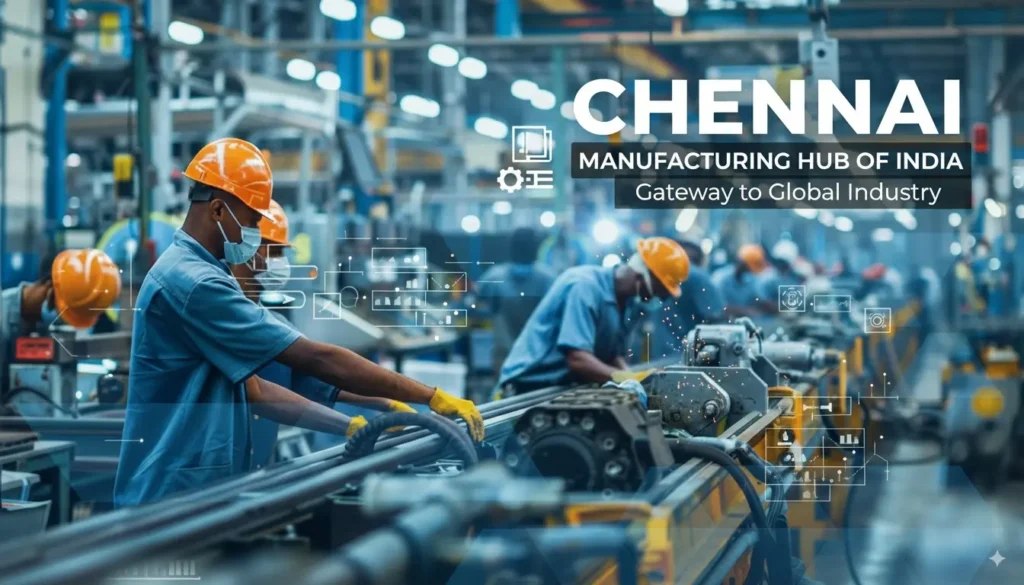 Chennai Assembly Unit[/caption]
Industry Partnerships
When evaluating AR/VR training institutes in Chennai, it’s important to choose academies that go beyond theory and provide direct industry exposure.
Immersive Skills Academy (ISA) stands out with its collaboration with the SAIK (Society of AVGC-XR Institutions in Kerala).
This network has strong ties with XR, Gaming, and Animation companies, giving learners opportunities to work on live projects during training.
Such partnerships ensure you gain practical, job-ready skills while still studying.
Government-Recognized Certification Programs
The value of an AR/VR certification depends on its credibility in the job market, and government recognition is a major differentiator.
ISA has launched two 6-month certification programs approved by Manonmaniam Sundaranar University through its JSR VSD Centre in Udumalpet, Tiruppur district.
ISA is among the first in India to receive UGC-DEB (Distance Education Bureau) approval for AR/VR programs.
Why This Matters
Certificates carry the credibility of a recognized state university.
Programs follow a structured curriculum aligned with national educational standards.
UGC-DEB affiliation ensures recognition across India and internationally, boosting career prospects.
Paid Internship Opportunities at AR VR Companies in Chennai, Kochi
Your journey into AR VR doesn’t have to wait until after graduation.
You’ll work on real client projects, understand workplace dynamics, and build a professional network before you even complete your course.These internships typically pay between ₹8,000 to ₹10,000 per month and give you invaluable industry exposure.
Flexible Learning Paths & Immersive Experiences
You have multiple options when it comes to how you want to learn AR VR technology. Weekend batches are perfect if you’re working professionals looking to transition into this field. Evening classes accommodate those with day jobs, while intensive boot camps can get you job-ready in just 3-4 months.
Online and hybrid models have become increasingly popular, especially after the pandemic. You can attend theory sessions online and visit the institute for hands-on lab work with VR headsets and AR devices. This flexibility means you don’t have to put your life on hold to pursue professional AR VR courses.
As part of the coursework, you will also be taken to the XR Experience Center at Komachi Park, Wayanad, where you’ll stay immersed in nature while completing hands-on XR exercises. This unique learning environment combines the tranquility of natural surroundings with cutting-edge technology training, providing an unparalleled educational experience that enhances both technical skills and creative thinking.
Fluency Development Skills (in Partnership with Speakili)
Technical expertise alone isn’t enough to succeed in the AR/VR industry. Effective communication skills are equally critical, especially when working with global technology companies.
Partnership with Speakili
ISA collaborates with Speakili to provide specialized English fluency training.
Focused on helping developers communicate complex technical concepts with clarity and confidence.
What You’ll Learn
Explaining AR/VR projects in simple, professional language
Participating in technical discussions & brainstorming sessions
Presenting ideas effectively to international audiences
Program Features
Technology-focused vocabulary building
Business communication skills for professional settings
Mock interviews and presentation practice
Collaborative exercises simulating real workplace scenarios
Why It Matters
Strengthens both technical communication and general fluency
Builds confidence for global client interactions
Enhances employability in the competitive AR/VR job market
Admission Requirements and Prerequisites

Enrollment Requirements for AR/VR Courses in Chennai
AR/VR training programs are designed to be accessible to learners from diverse backgrounds. Whether you’re a fresh graduate, a working professional, or a career switcher, there’s a pathway available for you.
Educational Background
No engineering degree required – students from science, commerce, or arts streams (12th grade and above) can enroll in foundational courses.
Backgrounds in computer science, IT, mathematics, or physics provide an advantage in grasping technical concepts.
For advanced certifications, a bachelor’s degree (any stream) is preferred, especially if you’ve had exposure to:
Programming
Graphics
Multimedia or design
Technical Skills Assessment
Programming knowledge is not mandatory, but familiarity with:
C#, JavaScript, or Python is a plus.
Experience with Unity or Unreal Engine is highly valued.
3D modeling skills (Blender, Maya, or even sketching) strengthen your profile.
Math skills – geometry, trigonometry, and spatial reasoning are important.
Don’t worry if you’re rusty → most courses include refresher modules.
Key factor: Problem-solving mindset matters more than memorizing formulas.
Age & Experience
Typical age range: 18–35 years (flexible for career changers).
No prior work experience required – many students come from non-tech fields.
Fresh graduates → enthusiasm & adaptability are strong assets.
Working professionals → transferable skills (project management, client interaction, creativity) complement technical training.
- Specialised Courses for AEC, Manufacturing Professionals as part of upskilling.
Part-Time Weekend & Evening Classes
Ideal for working professionals & career switchers
Weekend programs: Sat–Sun, 9 AM – 12 PM, duration 3–6 months
Weekday classes: Mon–Fri, between 10 AM – 5.30 PM, duration 3–9 months.
Benefits:
Learn while continuing your career
Apply AR/VR concepts directly in current projects
Extended learning timeline allows gradual mastery
Support: Recorded sessions & online resources available for flexibility
- Guided Interactive Learning Modules.
Online & Hybrid Formats
Online programs → 24/7 access to Video lectures, assignments, discussions
Daily 1 hr Live Session with Instructor
Access to Course Materials via our LMS Platform after live sessions.
Hybrid programs → Online Session + weekend lab sessions on campus
Hands-on with VR headsets, motion capture, rendering tools
Collaboration tools:
Virtual office hours for 1:1 instructor guidance
Investment and Financial Planning
Investing in an AR/VR career is a pathway to entering India’s rapidly growing spatial computing sector, which is currently experiencing a compound annual growth rate (CAGR) of over 38%. To make this transition accessible, Immersive Skills Academy offers flexible financial planning models designed for students and working professionals alike. Students can choose between upfront payment discounts, milestone-based installment plans, and low-cost EMI options provided through our banking and NBFC partners to spread the cost of tuition comfortably across their study period.

Course Fees & Payment Options
AR/VR training programs in Chennai are designed with flexible fee structures to make quality education accessible.
Fee Range
Basic certification courses: ₹60,000 – ₹1,20,000
Professional advanced programs: ₹90,000 – ₹2,29,000
Available Courses :
6 Month Certificate Course with Internship
Augmented Reality Bootcamp Course
Virtual Reality Bootcamp
Payment Models
Upfront Payment → 5–10% discount on total fees
Phase-wise Instalment → Common split:
50% at enrollment
30% mid-course
20% before certification
Monthly Payment Plans → Spread across course duration (small processing fee may apply)
Extra Savings:
Early bird discounts for online bootcamp : 10–20% (if enrolled 30–45 days early)
Group enrolments: 5–15% reductions
Return on Investment (ROI)
Entry-level AR/VR developers: ₹3.5 – ₹6 LPA
Mid-level professionals: ₹8 – ₹15 LPA
Specialised senior roles: ₹20+ LPA (gaming, healthcare, enterprise solutions)
Market Outlook:
India’s AR/VR sector → 38.29% CAGR growth
Cost recovery → Typically within 6–12 months of employment
Extra opportunities → Freelancing projects (₹25,000 – ₹2,00,000 per project)
Scholarships & Financial Aid
Merit-based scholarships → Cover 20–50% of fees
Government initiatives → Subsidized training under Skill Development Programs & PMKVY (availability varies)
Corporate sponsorships → Support for women in tech, minority groups, and rural students
Education loans → Partnerships with banks/NBFCs, often with moratoriums until course completion
Payment Options
Credit card Payment is accepted by our Gateway
- Pay directly via our Payment Gateway
Career Placement and Industry Support
Immersive Skills Academy bridges the gap between academic training and industry demand through a dedicated career placement program. Our students receive comprehensive support, including technical vocabulary building, portfolio development, mock interviews, and presentation training to prepare them for global technical environments. Through our established network of industry partnerships in Chennai’s automotive, manufacturing, and tech sectors, we actively connect graduates with leading recruiters at tech giants, specialized XR design studios, and engineering enterprises.

Career Opportunities
Job Roles in AR/VR Industry
Technical Roles
- AR/VR Developer: Create immersive applications and experiences
- 3D Artist: Design and model virtual environments
- UX/UI Designer: Design user interfaces for AR/VR applications
- Software Engineer: Develop backend systems and platforms
- Game Developer: Create VR/AR games and interactive experiences
- Technical Artist: Bridge gap between art and programming
Creative Roles
- Content Creator: Develop immersive storytelling experiences
- Animation Specialist: Create 3D animations for AR/VR
- Creative Director: Lead creative vision for projects
- Concept Artist: Design visual concepts for virtual worlds
- Sound Designer: Create immersive audio experiences
Business & Strategy Roles
- Product Manager: Oversee AR/VR product development
- Business Analyst: Analyze market trends and opportunities
- Project Manager: Manage AR/VR development projects
- Consultant: Advise businesses on AR/VR implementation
Entrepreneur: Start AR/VR focused companies
Conclusion
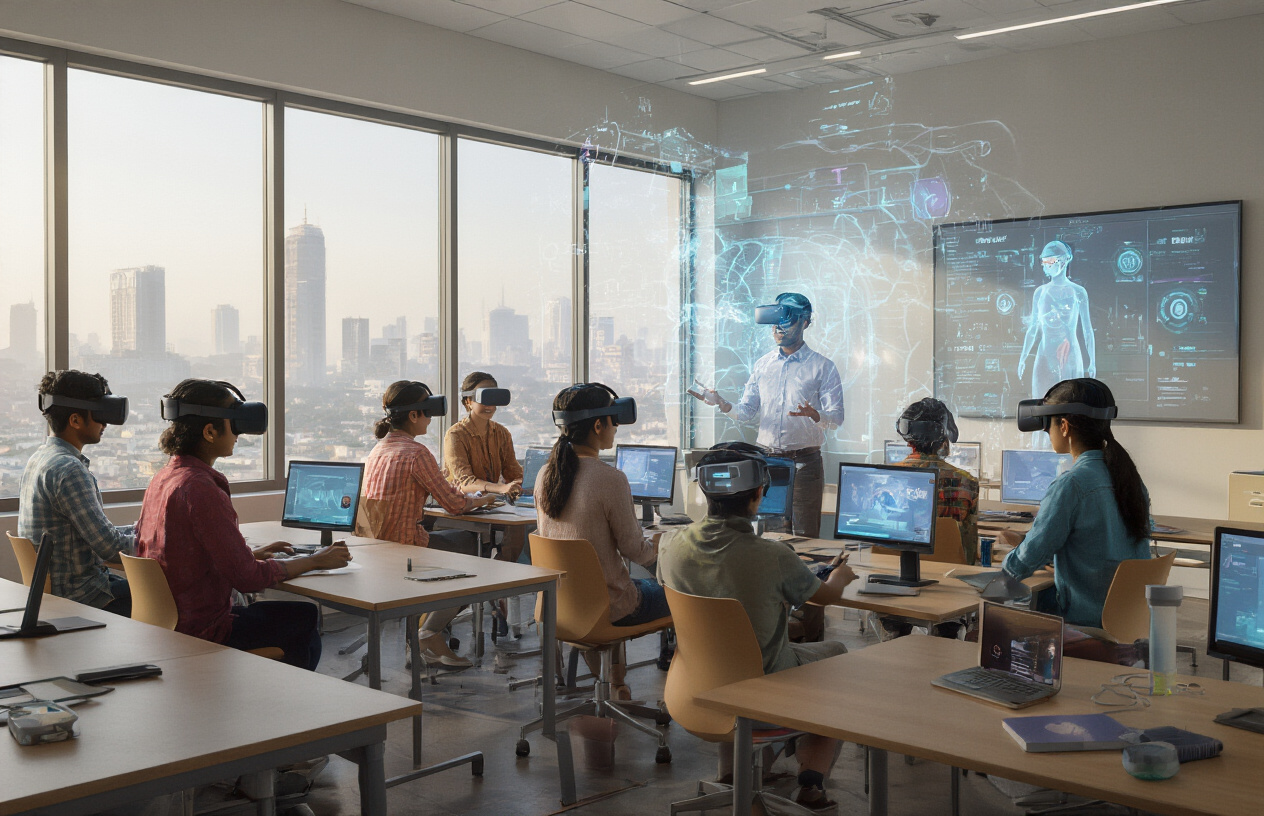
You now have all the information you need to make an informed decision about AR VR courses in Chennai. From understanding the core technology and career opportunities to selecting the right training institute with comprehensive curriculum, each step plays a crucial role in shaping your future in this exciting field. The skills you’ll develop – from 3D modeling and programming to user experience design – will open doors to industries ranging from gaming and entertainment to healthcare and education.
The investment you make in AR VR training today can transform your career trajectory tomorrow. With Chennai’s growing tech ecosystem and the increasing demand for AR VR professionals, choosing a course that offers flexible learning options, strong industry connections, and placement support will give you the competitive edge you need. Take the time to research institutes thoroughly, speak with current students or alumni, and align your choice with your career goals. Your journey into the immersive world of augmented and virtual reality starts with that first step of enrollment.